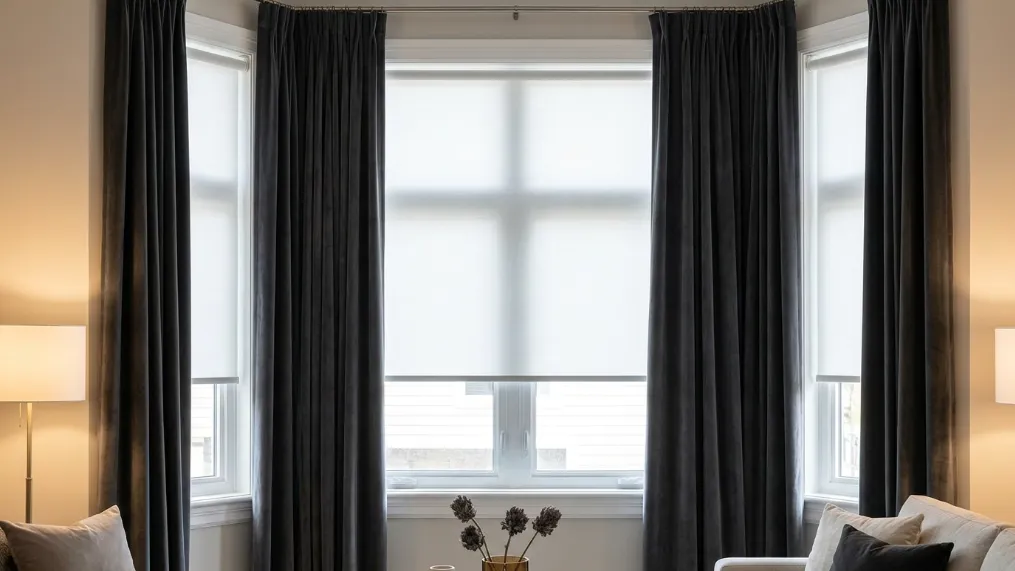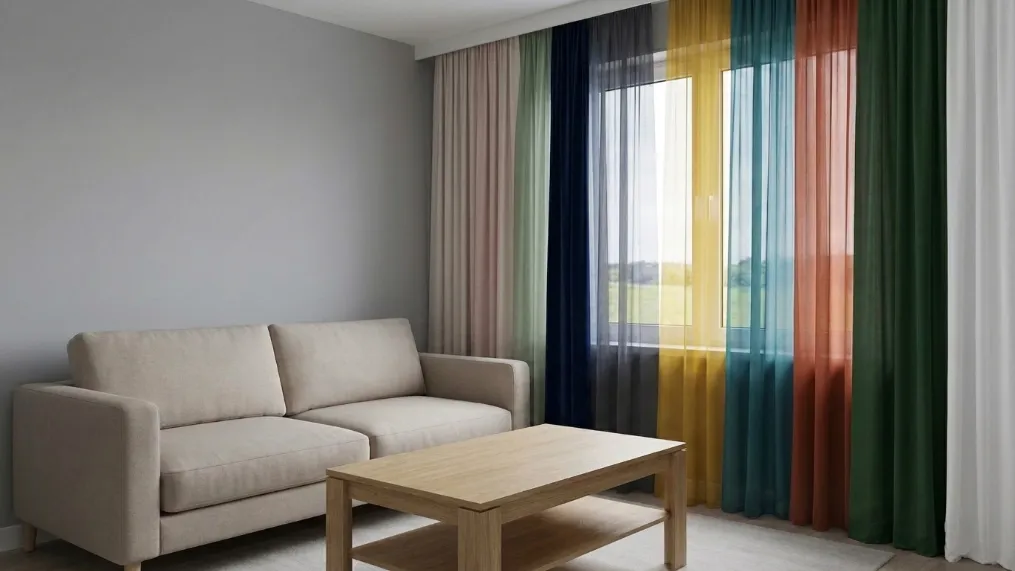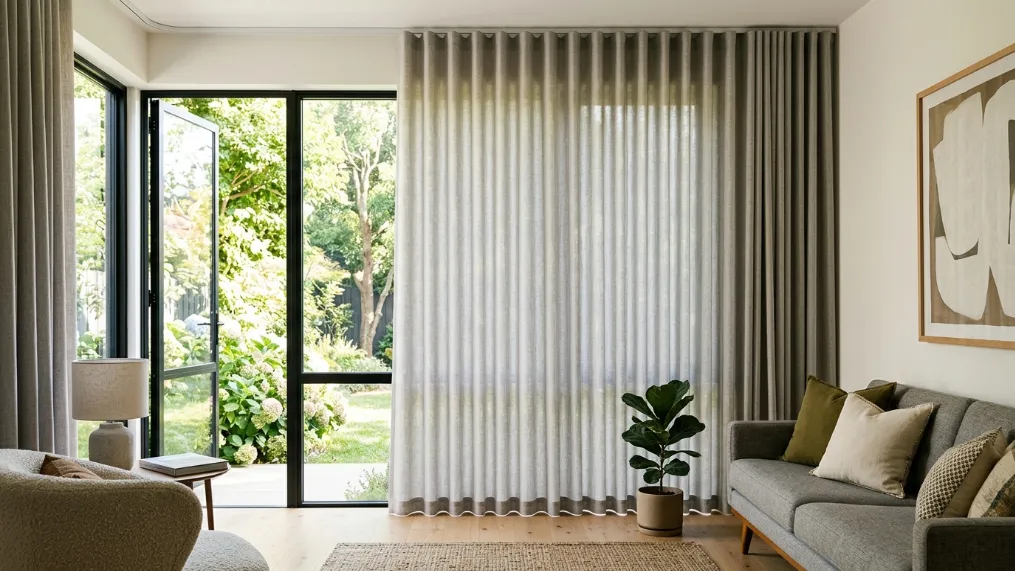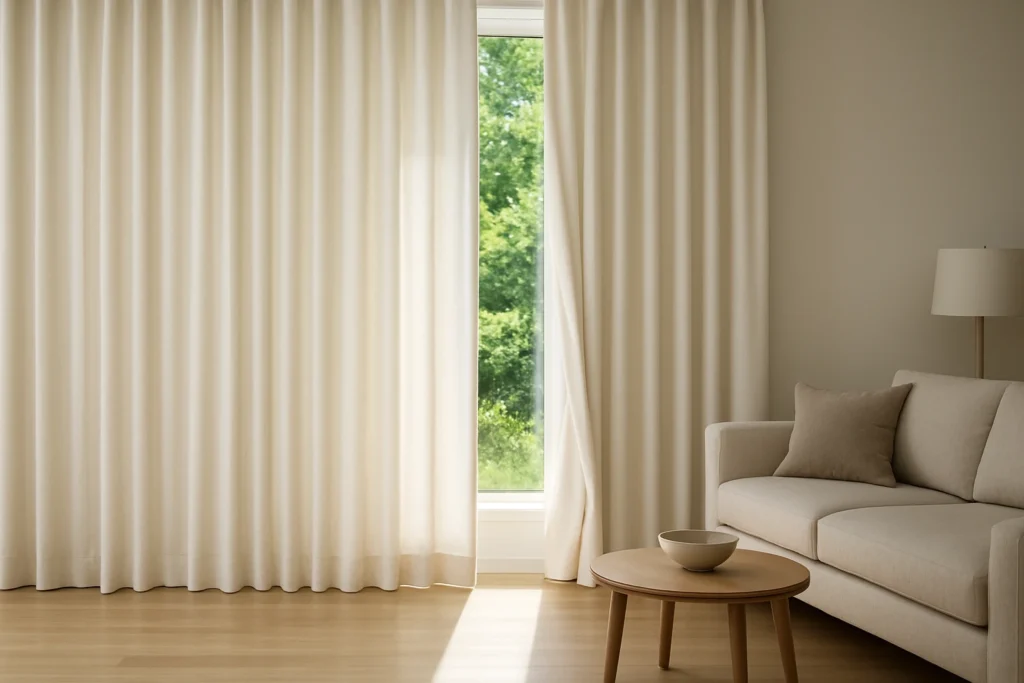
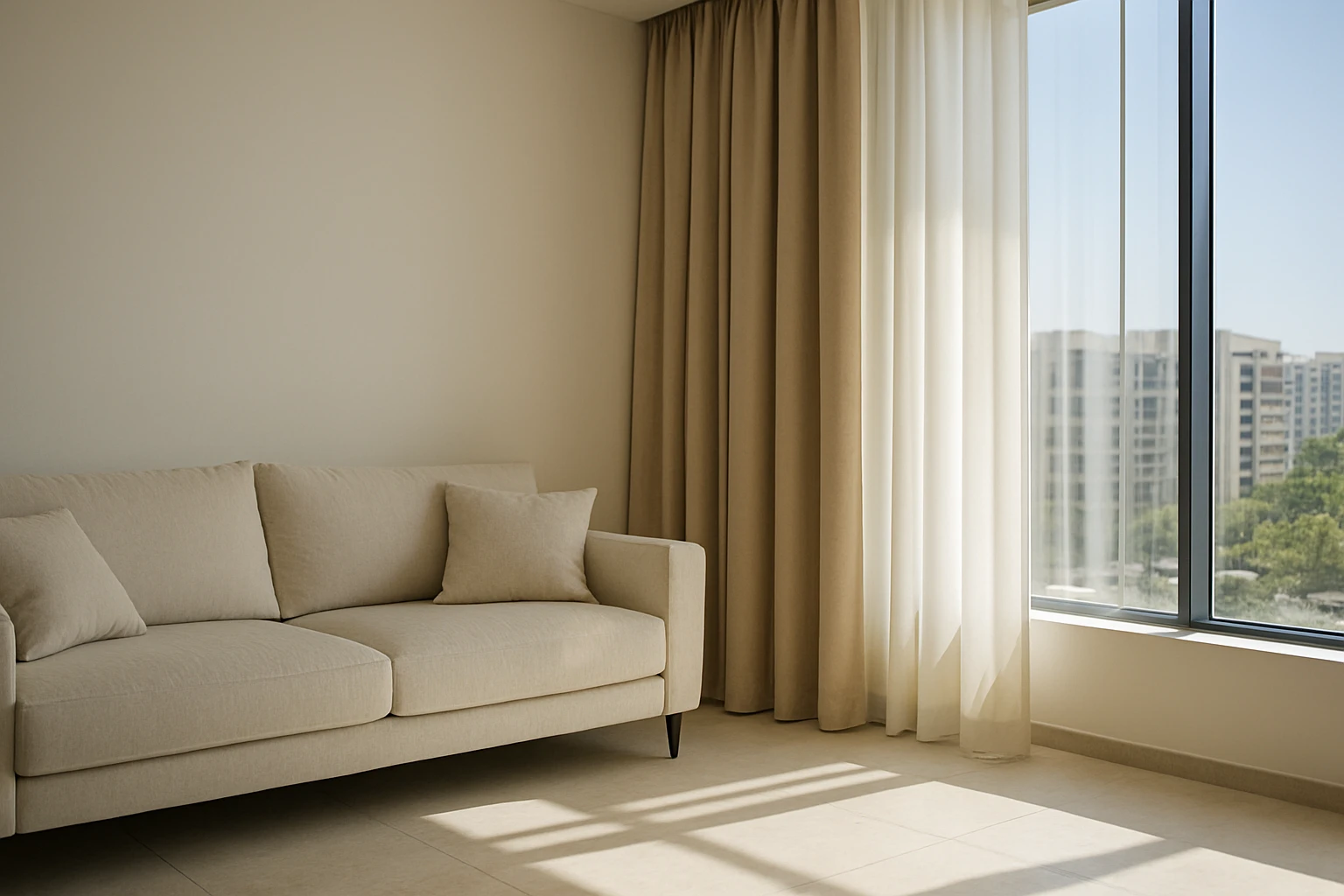
The best curtains for hot weather combine a light-colored, sun-facing backing with dense fabric and a close fit around the window. Thermal-lined blackout curtains are a good choice for sunny bedrooms, while a sheer layer behind lined curtains gives living rooms more control over daylight. Close the lined curtains before direct sun reaches the glass, because sheer fabric alone offers limited protection from strong summer heat.
Key Statistics
The U.S. Department of Energy reports that medium-colored draperies with white plastic backings can reduce heat gains by 33%. This finding applies to a particular curtain setup, not every blackout curtain, and it does not mean a 33% reduction in a home’s total cooling bill.
What Makes Curtains Effective in Hot Weather?
Curtains help keep a room cooler by reflecting some sunlight back toward the window and slowing heat movement between the hot window area and the room. The fabric, backing, coverage, and time you close them all affect the result.
A curtain does not produce cold air, and an indoor curtain cannot stop all the heat that sunlight brings through glass. Some sunlight passes through the fabric, while some is absorbed by the curtain and released as heat. This is why a pale window-facing backing matters, even when the room-facing fabric is dark.
Before you buy, know the difference between these three terms:
- Blackout describes how well a curtain blocks light. It does not, by itself, prove strong heat control.
- Thermal lining is an added layer designed to slow heat movement. How well it works depends on how it is made and how the curtain fits.
- Sheer fabric softens daylight and glare but usually gives much less protection from direct sun than a dense, lined curtain.
A common mistake is choosing the thickest fabric without checking its reverse side. A heavy, dark curtain with a dark backing may absorb a great deal of sunlight, so weight alone is a poor way to judge how well it will work in summer.
If you’re comparing curtain types, Arabic Curtains offers a useful starting point. When asking for samples, request both the face fabric and the proposed lining, since a small decorative swatch does not show how the full curtain is made.
Which Curtain Fabrics and Linings Should You Choose?
For a window that receives strong direct sun, choose a dense curtain with a pale, heat-control lining rather than an unlined decorative fabric. For a shaded window, a lighter lined fabric may offer enough comfort without making the room feel dark.

| Curtain Construction | Best Use in Hot Weather | Main Trade-Off | What to Check |
|---|---|---|---|
| Thermal-lined blackout curtain | Sunny bedrooms and rooms with strong afternoon sun | Blocks daylight while closed | Pale backing, edge coverage, and care instructions |
| Lined cotton or cotton blend | Living rooms needing a softer fabric finish | Heat control depends heavily on the lining | Whether the lining is included in the quote |
| Dense polyester with suitable backing | A practical option for many sunny rooms | Fabric quality and backing vary by product | Backing details, cleaning limits, and any heat-performance evidence |
| Unlined linen or linen-look fabric | Shaded windows where daylight matters most | Open weaves let sunlight through | Hold the sample against daylight to see the gaps |
| Sheer plus a separate lined curtain | Rooms needing daytime light and stronger sun control at different times | Needs two tracks and more space | Enough clearance for both layers to move freely |
| Velvet with a suitable lining | Rooms where darkness and a heavy drape are wanted | Heavy, bulky, and often harder to clean | Track load capacity and the window-facing backing |
Blackout and Thermal Curtains Are Not the Same
Blackout curtains are useful when you need to sleep in a sunny room, but the blackout label mainly tells you about light blocking. A multilayer woven blackout fabric and a coated blackout lining can look similar from the room while behaving differently in sunlight.
Ask the supplier what makes the product suitable for heat control. A clear answer should describe the lining or backing and, where available, include test results for that product. Treat claims such as “100% heat blocking” with caution, because curtains still have edges, gaps, and surfaces that exchange heat with the room.
Natural Fibers Are Not Automatically Cooler
Linen and cotton can feel pleasant in hot weather, but curtains work differently from clothing. Breathability may help a shirt feel comfortable, while an open curtain weave lets more sunlight reach the room.
If you prefer a linen look, choose linen or linen-look face fabric with a separate lining. That keeps the texture you want without relying on a loose weave to control summer sun. This difference also matters when choosing curtains for Dubai’s climate, where strong sunlight and air-conditioned rooms place different demands on fabric and backing.
Does Curtain Color Matter More Than Thickness?
The color facing the glass matters more for reflecting sunlight than the decorative color facing the room. A pale backing is usually a better choice for a sunny window than a dark backing, while thickness alone does not tell you how much heat from the sun a curtain will absorb.
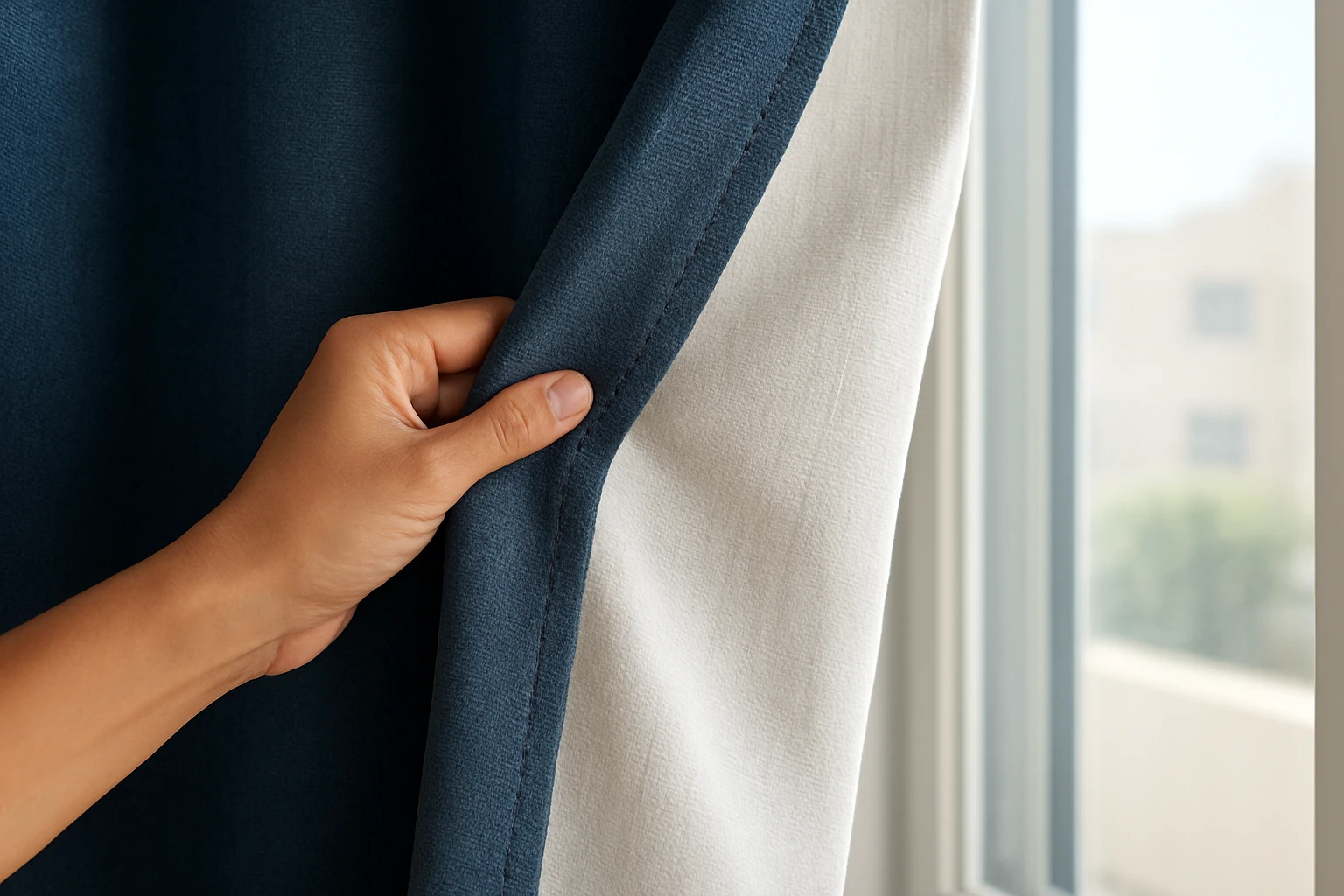
White curtains, cream curtains, and beige curtains suit a light summer color scheme, but color is only part of the choice. An unlined white sheer will usually give less shade than a darker curtain with a dense, pale-backed lining.
You can still use blue curtains or grey curtains if those colors suit the room. Ask for a pale reverse side rather than assuming the visible color must be light.
Compare samples beside the actual window in daylight. Look at both sides, check how much light comes through, and ask whether the final curtain uses the same lining as the sample. A small showroom swatch under ceiling lights can hide an open weave or a thin backing.
How Should Curtains Fit to Reduce Summer Heat?
Curtains work better when they cover the whole window with plenty of overlap and few open gaps. A wide, well-fitted curtain with a suitable lining is usually a better choice than an expensive fabric that leaves strips of glass exposed.
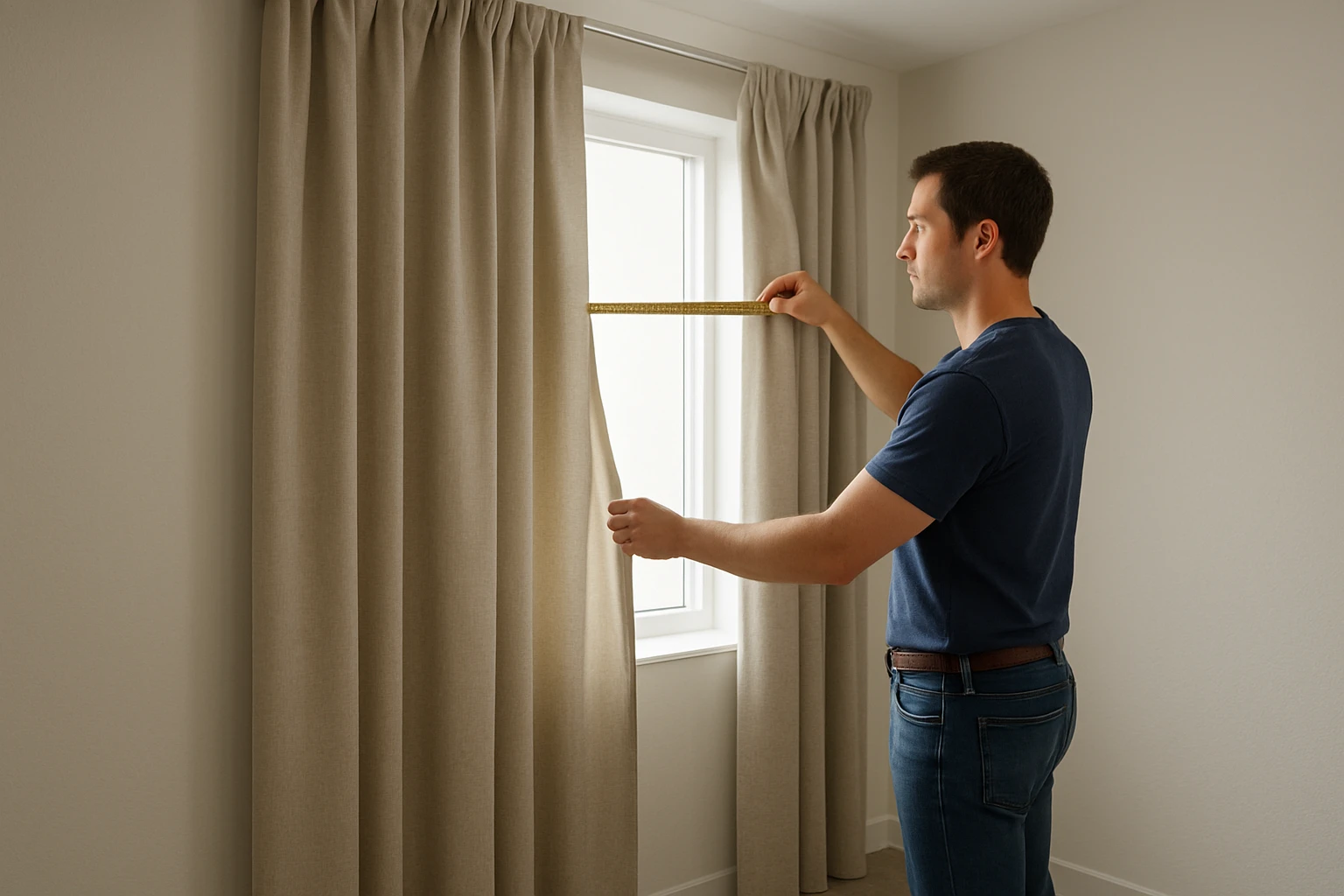
Use these steps when measuring or discussing installation:
- Measure the full glass area. Include every pane that needs shade, not just the part of the window that opens.
- Allow coverage beyond the sides. Around 15 to 25 cm beyond each side is a useful starting point where wall space allows, but the right amount depends on the window and track design.
- Reduce the top gap. A ceiling track or a properly fitted pelmet, which is a cover over the curtain top, can reduce the open space above the fabric.
- Plan the middle join. Two panels should meet without leaving a bright slit. An overlap track can help where the curtain system supports it.
- Bring the ends toward the wall. Side returns, where the outer curtain edges turn back toward the wall, help reduce open side gaps.
- Choose a practical hem. A curtain can finish just above the floor without pooling, which makes cleaning easier and avoids dragging fabric through dust.
Do not confuse curtain width with window width. For example, a 2-meter track might need about 4 meters of finished panel width for a heading designed to use twice the track width. That is an example, not a cutting rule for every curtain: wave headings, pleats, hems, and fabric patterns affect how much fabric you need to order.
Leave Room for Layers and Airflow
A sheer layer and a lined layer need enough space between them to move without catching. If the tracks are too close, the outer curtain can drag the sheer along and leave part of the window uncovered.
Keep curtains clear of air-conditioning supply and return grilles, because blocked airflow can make the room less comfortable. Do not cover heaters, vents, window handles, or access points, and follow the equipment maker’s clearance guidance. Where doors open onto a balcony, check that the curtain can gather to the side without blocking the handle or walking route.
When Should You Open and Close Curtains in Summer?
Close lined curtains before direct sunlight reaches the window, rather than waiting until the room feels hot. Use sheers for softer daylight when the window is shaded, then draw the lined layer during the strongest sun.
The sun’s direction matters more than a fixed rule such as keeping every curtain closed all day. In Dubai and elsewhere in the Northern Hemisphere, east-facing windows usually receive morning sun, while west-facing windows receive afternoon sun. Nearby buildings, balconies, and seasonal sun angles can change how much sun actually reaches the glass.
| Window Situation | Practical Curtain Routine | Reason |
|---|---|---|
| East-facing bedroom | Close the lined layer before morning sun reaches the glass | Limits early solar heating and bright light |
| West-facing living room | Draw the lined curtain before afternoon sun enters | Reduces heat gain during a hot part of the day |
| Window shaded by a deep balcony | Use sheers when daylight is useful, adding the lined layer as needed | Avoids making a shaded room darker than necessary |
| Large sunny window while nobody is home | Keep the heat-control layer closed during direct sun | Reduces sun exposure without sacrificing daylight someone needs |
| Window opened for cooler outdoor air | Move curtains clear of the opening | Keeps fabric from restricting useful airflow |
For example, a west-facing home office may stay comfortable with sheers through the morning, then need its lined curtains closed before sunlight reaches the desk. The right closing time will shift through the year, so watch when the sun reaches the window rather than following a fixed timetable.
Motorized curtains can make this routine easier on wide or hard-to-reach windows. When comparing electric curtain systems, check whether the proposed controls allow timed closing, since some motors need an added controller for scheduling.
Opening curtains after sunset uncovers the glass, but opening windows is a separate choice. In hot, humid weather, bringing outdoor air into an air-conditioned room may add heat and moisture rather than cool it. Open windows for cooling only when outdoor conditions are suitable and it is safe to do so.
Which Setup Makes Sense for Your Room?
For a sunny bedroom, choose a pale-backed, thermal-lined blackout curtain with good edge coverage. For a living room that needs daylight, choose a separate sheer and lined curtain so you can control light without keeping the room dark all day.
Use the room’s main problem to narrow the choice:
- Strong afternoon sun and poor sleep: Choose good blackout fabric, suitable lining, and panels that meet fully in the center before focusing on decorative details.
- A bright living room with changing light: Use two layers, and close the lined layer only when the window receives direct sun.
- A small window with little room beside it: Consider a close-fitting blind behind the curtain, which may cover the glass more neatly than a bulky curtain alone.
- A shaded room that still feels hot: Check for heat from the roof, walls, air leaks, appliances, or poor air-conditioning airflow before spending heavily on curtain upgrades.
A blind and curtain can solve different parts of the problem. The blind covers the glass more closely, while the curtain adds side overlap and a softer look. These ways to pair curtains and blinds can help you choose layers without leaving the window crowded or hard to use.
Curtains have limits, especially on large areas of glass exposed to strong sun. Outdoor shading can stop sunlight before it reaches the glass, so approved awnings, shutters, or balcony shade may be worth considering where the building allows them. Do not apply window film without checking glass compatibility, the window warranty, and building rules.
Before ordering curtains for hot weather, ask the supplier to confirm the face fabric, lining, track width, side returns, finished length, and cleaning method in writing. That makes quotes easier to compare and helps avoid paying for a good-looking curtain that leaves the main source of heat uncovered.
Frequently Asked Questions
Can I Add Thermal Lining to Curtains I Already Own?
You can often add thermal lining to existing curtains if the fabric, heading, and track can support it. A curtain maker should check the extra weight and how the new lining will attach. Separate clip-on linings may be an option, but they still need enough width and length to cover the window well.
Can I Machine-wash Thermal Blackout Curtains?
Machine-wash thermal blackout curtains only when the care label specifically allows it. Some coatings and bonded layers can crack, peel, or separate with heat, strong detergents, or rough washing. Check the instructions before buying, especially for large curtains that may be too heavy for a domestic machine when wet.
Are Thermal Curtains a Good Option for a Rented Apartment?
Thermal curtains can suit a rented apartment if the existing track can carry their weight and the installation follows your lease. Ask permission before drilling, adding a pelmet, or changing fixed fittings. Keep the original curtains and hardware so you can restore the window when you move out.
Will Heat-blocking Curtains Also Reduce Traffic Noise?
Heat-blocking curtains may soften some sound, but they should not be treated as soundproofing. Heavy fabric and deep folds can reduce echoes inside a room, while traffic noise also enters through glass, frames, gaps, and vents. If noise is the main problem, look for sound-test results rather than relying on a thermal label.
Can Thermal Curtains Cause Condensation Behind the Fabric?
Condensation can form behind curtains when moist air reaches a surface cold enough for water to collect. Closely fitted curtains may hide the moisture, so check the glass, frames, and lining if you notice dampness or a musty smell. Address excess humidity and ventilation problems rather than leaving wet fabric against the window.