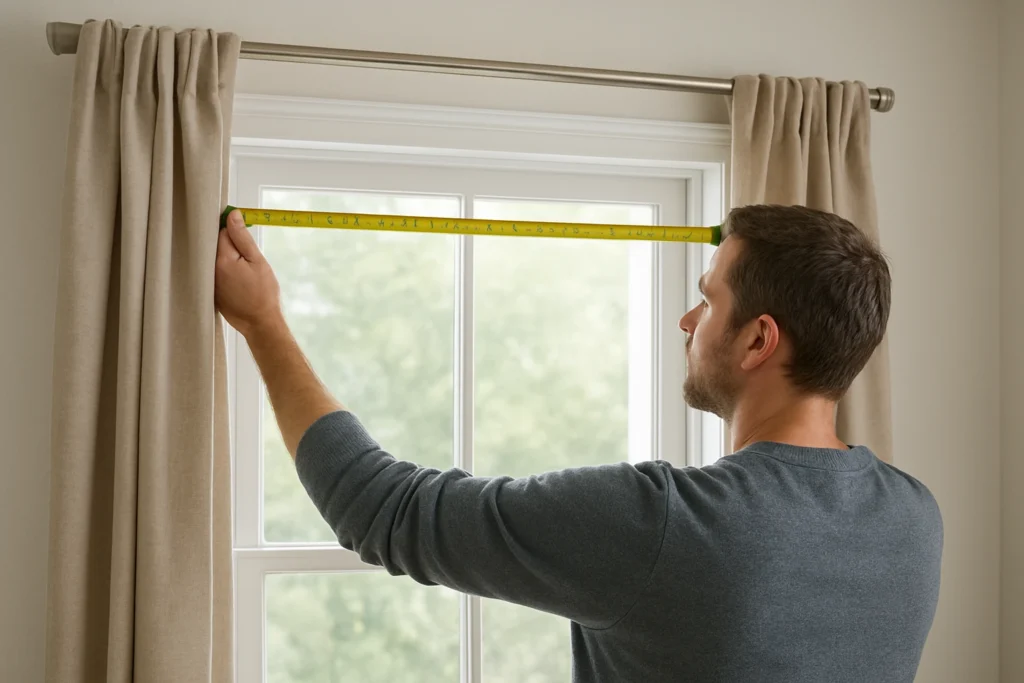
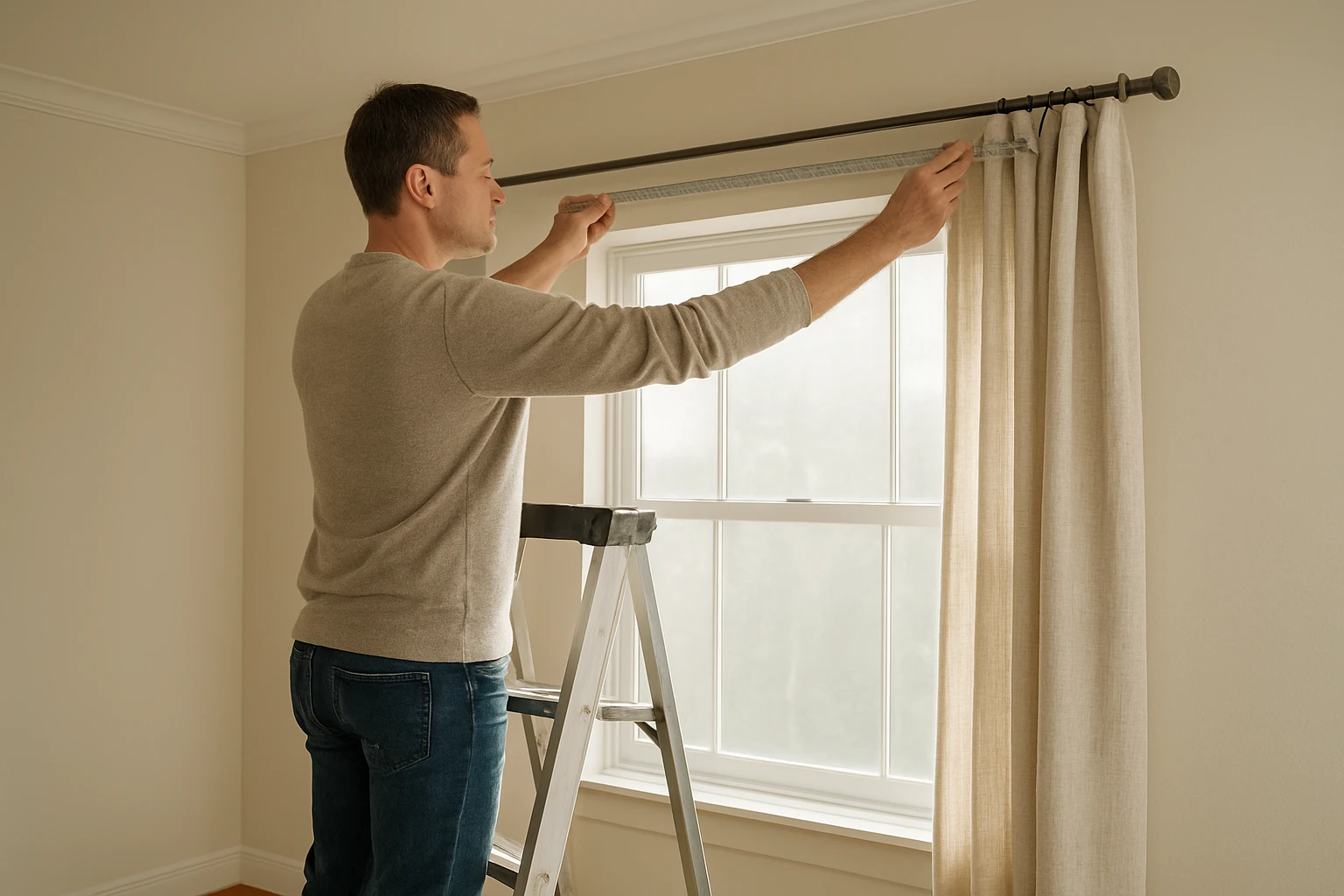
To measure for curtains, measure the usable width of the pole or track, then measure from the correct hanging point to where you want the hem to finish. For many flat curtain panels, the combined fabric width should be about 1.5 to 2.5 times the pole or track width, depending on the heading and the folds you want. Check the seller’s measuring guide before ordering, because ready-made panels, pleated curtains, and wave curtains can use different width and length rules.
What to Check Before You Measure
Choose the curtain heading and decide where the pole or track will sit before taking final measurements. The heading is the top of the curtain that attaches to the pole or track. Its shape affects both the width you need and where you start measuring the drop, which means the curtain length.

Use a steel tape measure, a pencil, and a notebook. A soft sewing tape can bend or sag across a wide window, which makes it harder to get a reliable width. For a high window, use a stable stepladder and ask another person to help hold the tape rather than stretching across the opening.
Write every size as width x drop, and keep all measurements in one unit. Centimetres are often easier for room measurements, while some custom curtain suppliers ask for millimetres. Record what you measured as well as the number, such as “track width, 240 cm,” rather than writing “240” on its own.
Before choosing where to fit the pole or track, check for:
- Window handles and doors that swing into the room.
- Deep window sills, radiators, and air-conditioning vents.
- Ceiling coves, cornices, and hidden curtain pockets.
- Blinds that will sit behind the curtains.
- Wall space where the open curtains can gather.
If you are comparing curtain types, settle on the heading before placing a final order. Arabic Curtains can use your measurement notes to discuss suitable options, but the window size alone does not tell you the finished curtain size.
How to Measure Curtain Width
Measure the usable length of the curtain pole or track, not just the glass or window frame. Curtains need enough width to cover the full hanging area when closed, including any extension beyond the window.
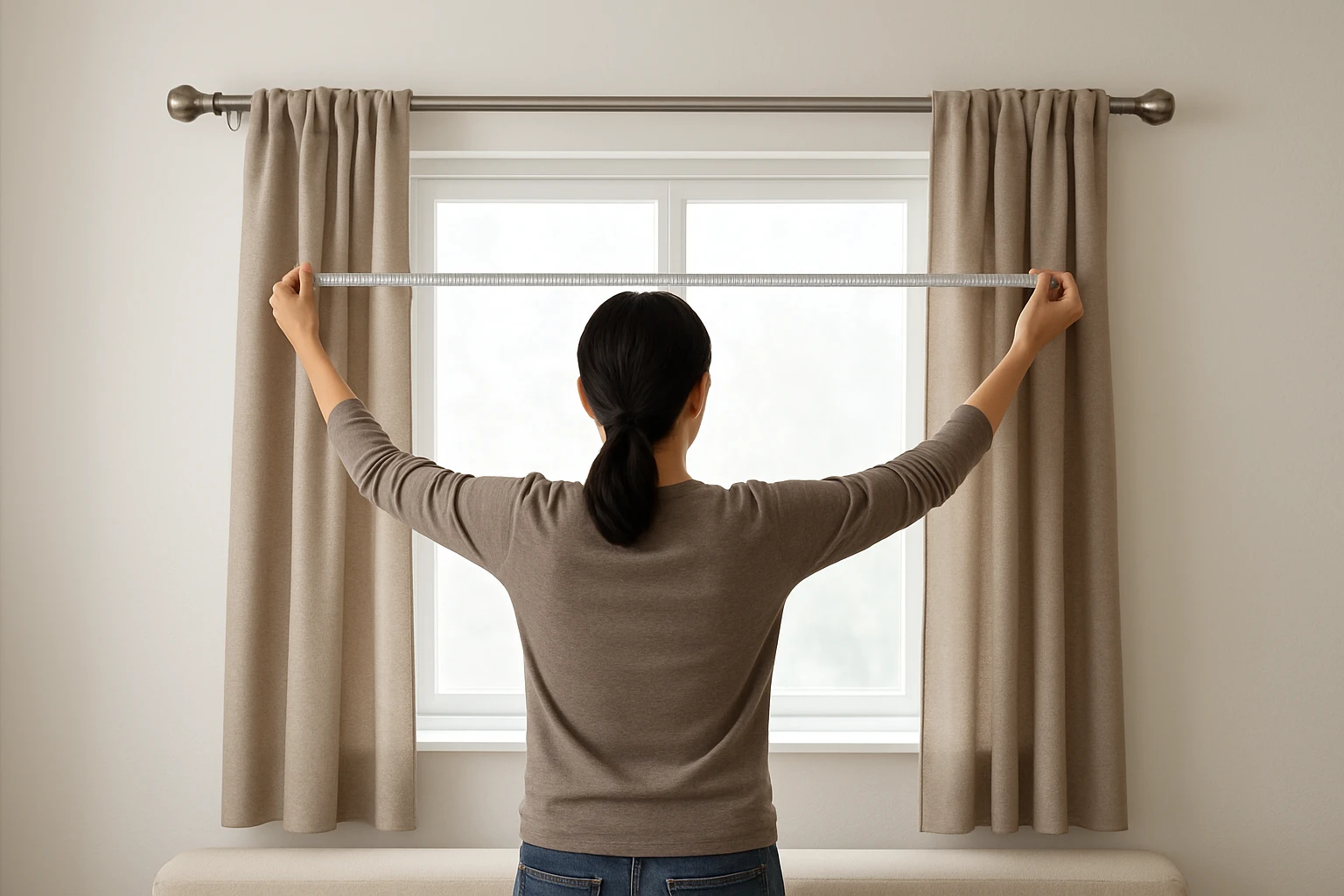
For an existing straight pole, measure between its usable ends and leave out the finials, which are the decorative end pieces. For a straight track, measure the full length along which the curtains can run. If the track has bends, returns toward the wall, or an overlap arm at the centre, record those details separately and follow the supplier’s measuring method.
If you have not fitted the pole or track yet, start by planning its position:
- Measure the outside width of the window frame or trim.
- As a starting point, allow around 15 to 30 cm of pole or track beyond each side where wall space permits.
- Check whether that space will hold the curtains when they are open.
- Mark the planned ends and measure between them to get the proposed pole or track width.
For example, a 160 cm window with 25 cm of extension on each side needs a pole or track about 210 cm wide. The 210 cm measurement, rather than the 160 cm window width, is the starting point for working out how much curtain width you need.
That extension is a planning allowance, not a fixed rule. Thick lined curtains take up more space when open than light sheers, so 15 cm on each side may still leave much of the glass covered. The space taken up by the gathered curtains is called the stackback. If you want to keep the glass clear, ask the supplier how much stackback your chosen fabric and heading will need.
For blackout curtains, think about the edges as well as the fabric. A curtain that barely covers the frame can leave bright gaps at the sides and top, even when the fabric blocks light well. Extra coverage and a suitable track position help, though curtains alone may not make a room fully dark.
How Much Curtain Width Do You Need?
For curtains sold by their flat fabric width, multiply the pole or track width by the fullness you want. Fullness is the extra fabric that forms folds when the curtains are closed, so a greater total fabric width gives a fuller look.

The ranges below are useful for planning flat-width panels. Follow the curtain maker’s instructions if they differ, especially for stiff fabric, heavy lining, or a fixed pleat design.
| Curtain Style | Common Planning Fullness | What to Check Before Ordering |
|---|---|---|
| Eyelet or grommet panels | About 1.5 to 2 times the pole width | More width creates deeper folds but needs more space in front of and behind the pole |
| Pencil pleat curtains | About 2 to 2.5 times the track or pole width | Check whether the listed width is before or after the heading tape is gathered |
| Lightweight sheer panels | Often about 2 to 2.5 times the hardware width | A fuller sheer gives more folds, but it does not provide night-time privacy by itself |
| Pinch pleat curtains | Use the maker’s finished-width method | The pleats may already be built into the quoted coverage width |
| Wave curtains | Use the track system’s specified fullness | Glider spacing and heading tape must work together |
For ordinary flat-width panels, the calculation is:
Total flat curtain width = pole or track width x fullness factor
For example, a 220 cm pole at 2 times fullness needs 440 cm of total flat curtain width. With a pair of equal curtains, each panel needs to be about 220 cm wide before gathering.
A common ordering mistake is to confuse a panel width with a pair width. A listing that says “width 220 cm” might mean one panel is 220 cm wide, or it might describe the total width of the pair. Check the product wording before paying, and confirm how many panels the pack contains.
Do not multiply a made-to-measure supplier’s finished coverage width by two unless asked. Many suppliers want the actual track width and calculate the fabric allowance themselves. Giving them an already doubled measurement can result in far too much fabric.
Wave curtains need particular care because the folds depend on the track gliders and heading tape. Choose the wave system first rather than buying fabric panels and hoping they will fit an unrelated track.
How to Measure Curtain Length
Measure curtain length from the hanging point specified for your heading to the chosen hem position. Measure at the left, centre, and right, because a small slope in the floor or pole or track can make one side drag.
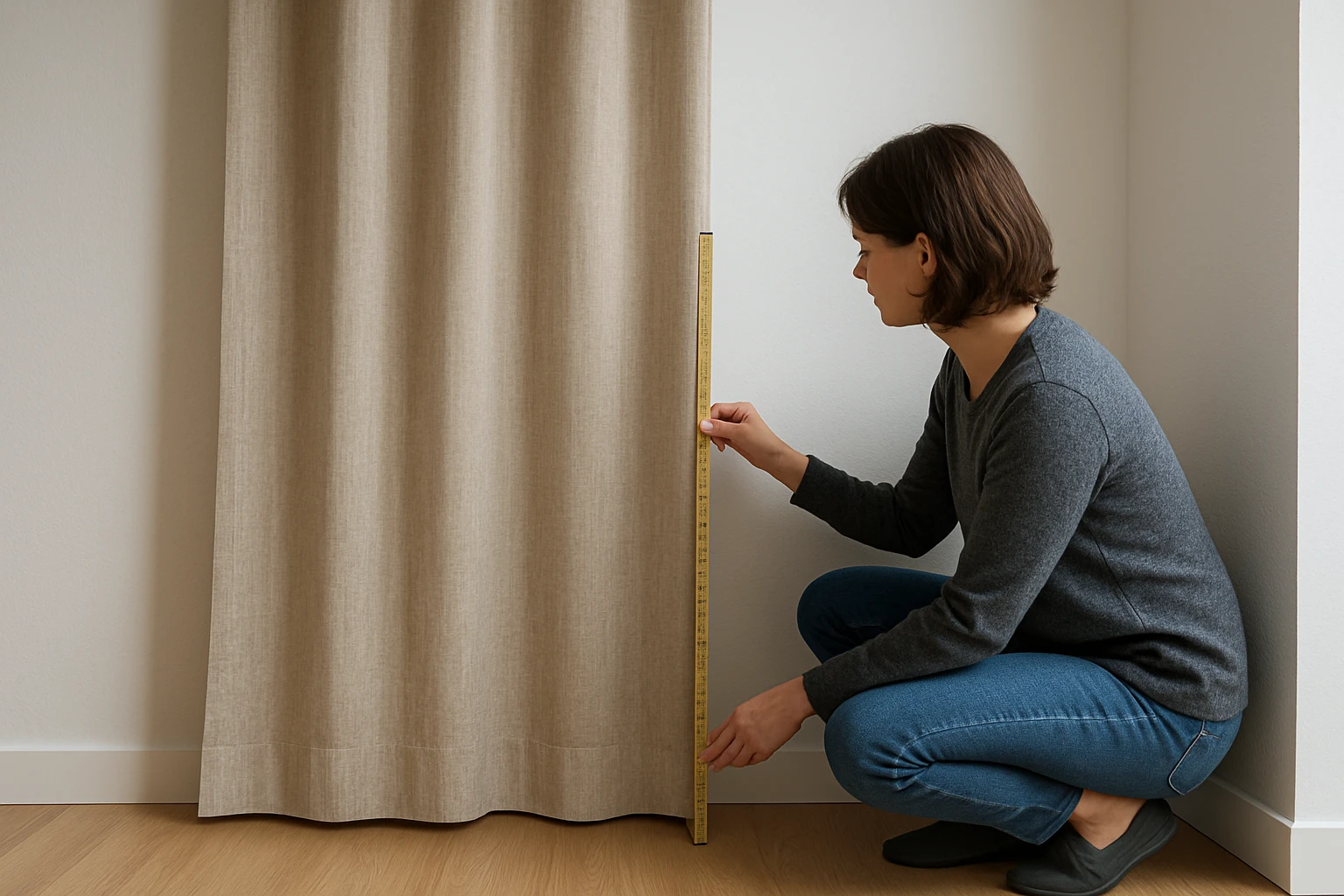
Choose where you want the hem to finish before measuring, rather than measuring to the floor and deciding later. These are practical starting points, not rules that suit every room.
| Hem Position | Typical Starting Point | When It Makes Sense |
|---|---|---|
| Above the sill | About 1 cm above the sill | Where a deep sill stops a curtain from hanging freely |
| Below the sill | About 10 to 15 cm below the sill | Where there is clear wall space and no heat source or other obstacle |
| Just above the floor | About 1 to 2 cm clear of the floor | For daily use, easier cleaning, and sliding doors |
| Touching the floor | Hem just meets the floor | For a tailored look on a reasonably level floor |
| Puddled on the floor | Extra length chosen for the desired effect | For decorative curtains that are rarely opened |
Keep fabric clear of radiators, heaters, and vents according to the equipment maker’s safety instructions. A standard below-sill allowance is not a safe substitute for those clearances.
Where to Start for Each Curtain Heading
The correct starting point depends on how the curtain hangs, so do not measure from the ceiling or the top of a bracket unless the supplier specifically asks for that measurement.
| Heading or Hardware | Usual Measuring Reference | Detail That Can Change the Order |
|---|---|---|
| Pole with rings and hooks | The curtain hook attachment point on the ring | Hook position can change how much fabric sits above the attachment |
| Curtain track | The attachment point on the glider or hook | Some suppliers ask for the underside of the track and make their own allowance |
| Eyelet or grommet curtain | Often the top of the pole down to the hem position | Fabric rises above the eyelet, so the supplier must explain whether to add that rise |
| Tab top curtain | The seller’s stated top-of-tab reference | Tab size and the way it sits around the pole affect the final position |
| Rod pocket curtain | The seller’s specified pole or pocket reference | The pocket and any fabric above it affect the hanging length |
For eyelet curtains, do not guess how much fabric to allow above the pole. Ready-made curtain length is commonly stated from the top fabric edge to the hem, while a measuring guide may ask for the distance from the pole to the floor. Those are not the same measurement.
For hooked curtains, adjustable hooks can help with small changes, but they should not be used to correct a large measuring error. Raising the curtain too far can make the heading rub against the track or expose the hardware.
How to Handle an Uneven Floor
For curtains that must clear the floor, use the shortest of the left, centre, and right measurements, then subtract your chosen clearance. This prevents the hem from dragging at the highest point of the floor.
For example, if the three readings are 248, 247.5, and 247 cm, a 1 cm clearance gives a hanging distance of 246 cm. That is the distance from your chosen hanging point to the hem, not necessarily the finished fabric length for every heading.
If you want the fabric to touch the floor across a sloped area, ask about an uneven or shaped hem. A straight hem cannot stay equally close to a floor that changes height. The guide to whether curtains should touch the floor explains the practical differences between these finishes.
Measuring Layered, Motorized, and Shaped Windows
Measure each curtain layer and each separate track on its own. Sheers, blackout panels, motors, and curved tracks can need different clearances, even when they cover the same window.
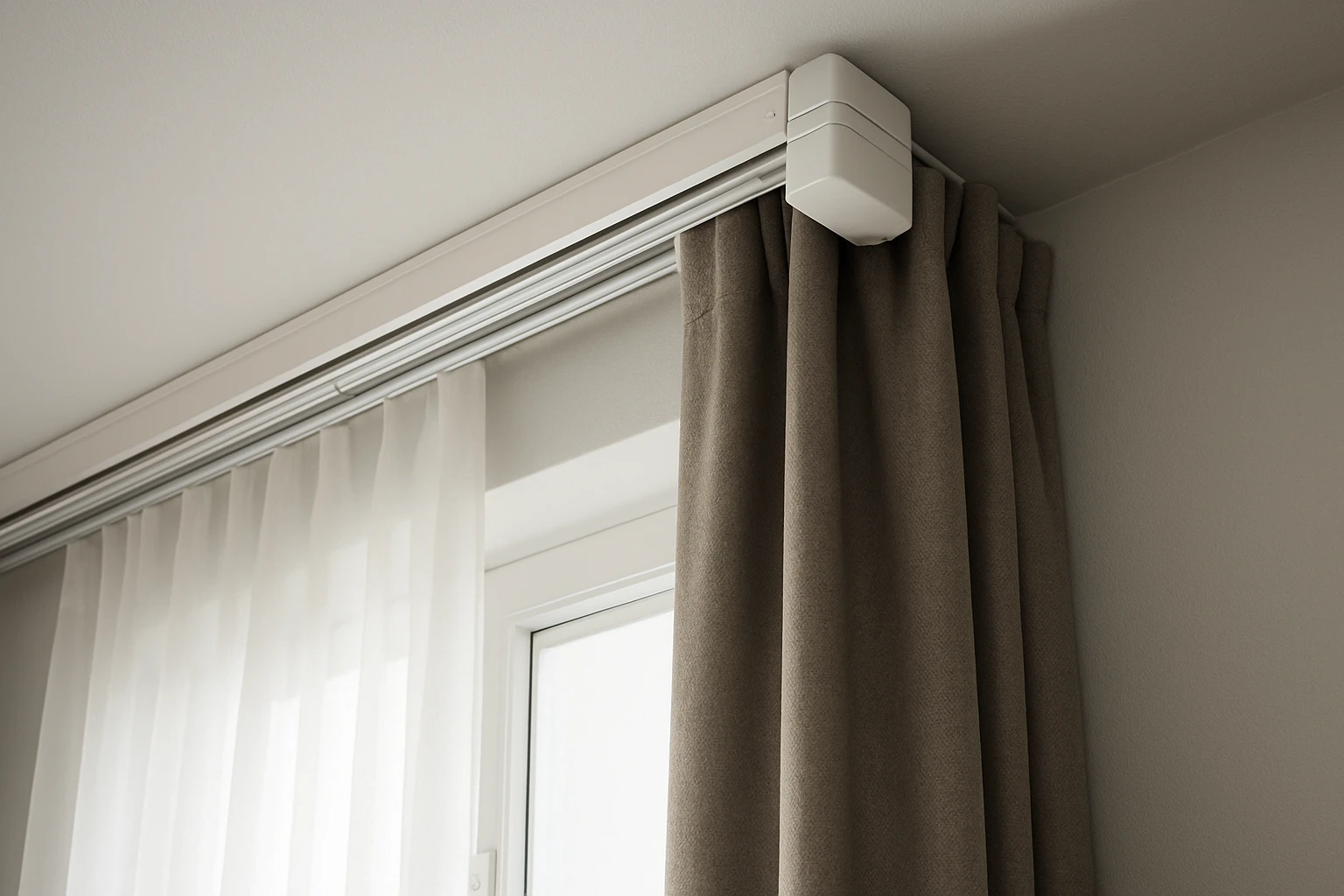
For two layers, record both track widths and both drops rather than assuming they match. Check that the rear curtain clears the window handle and the front curtain clears the rear fabric. Deep eyelet folds and thick linings need room to move, so tracks or poles fitted too close together can cause the curtains to drag even when the width is correct.
When pairing curtains and blinds, measure how far the blind projects from the wall, including its brackets and handles. The curtain must pass in front without catching when either the curtain or blind moves.
For motorized curtains, confirm the track model, motor position, opening direction, and power route before ordering fabric. A motor or drive unit can take up space at one end, while a centre-opening track may use an overlap that changes how the leading edges meet.
If you are planning electric curtains inside a ceiling pocket, record the pocket’s clear width, depth, and height as well as the window size. The installer needs access to the motor and fixings, not just enough room to hide the fabric.
Bay windows and corner windows need a different approach from a single straight pole. Measure each straight section, mark the corners on a simple sketch, and record the return toward each wall. Do not pull the tape diagonally across a bay and use that number as the track length. For bent tracks, the bend angles and the track’s distance from the wall affect the final fit, so have the supplier confirm the layout before making the track.
Sliding doors also need a movement check. Make sure the open curtain stack stays clear of the door handle and the main walking route, rather than simply dividing the available wall space equally on both sides.
A Complete Curtain Measurement Example
A useful curtain measurement record separates the pole or track width, fabric width, and hanging distance. Keeping those figures apart makes it much harder to order a doubled width or a drop taken from the wrong point.
Suppose a window is 170 cm wide, and there is enough wall space for 25 cm of track beyond each side. The planned track width is 220 cm, and the chosen curtains are a pair of pencil pleat panels sold by their flat width.
| Item | Example Measurement or Calculation |
|---|---|
| Window frame width | 170 cm |
| Track extension | 25 cm on each side |
| Total track width | 170 + 25 + 25 = 220 cm |
| Chosen fullness | 2 times the track width |
| Total flat fabric width | 220 x 2 = 440 cm |
| Flat width per panel | 440 divided by 2 = 220 cm |
| Hook-point-to-floor readings | 242, 241.5, and 241 cm |
| Shortest reading | 241 cm |
| Desired floor clearance | 1 cm |
| Target hook-point-to-hem distance | 240 cm |
In this example, two panels at 220 cm flat width each provide the chosen fullness. The target hanging distance is 240 cm, but the supplier still needs to confirm the finished fabric drop because the heading can extend above the hook point.
If the same order goes to a made-to-measure supplier that asks for track width, provide 220 cm and specify the heading and fullness you want. Do not enter 440 cm into its track-width field, because the supplier may apply fullness again.
Check These Details Before You Order
Before ordering curtains, match your notes to the seller’s exact size fields and measuring guide. A correct measurement entered into the wrong field can still produce the wrong curtain.
Use this final check:
- Confirm whether the width is for one panel, a pair, or the whole track.
- Confirm whether the quoted width is flat fabric width or finished coverage width.
- Check that the heading suits the pole or track, including the eyelet diameter where relevant.
- State exactly where you started the drop measurement.
- Confirm the hem position and any floor clearance.
- Note centre overlaps, wall returns, one-way opening, or unequal panel widths.
- Check window handles, doors, vents, and the space needed for open curtains.
- Ask whether the supplier makes any allowances or deductions, and avoid making the same adjustment twice.
For ready-made curtains, choose a suitable width first and compare the available drops with your target hanging distance. A longer panel may be shortened if its fabric and construction allow it, but a short panel usually cannot be made long enough without a visible change.
For custom curtains, keep your original room measurements alongside the final order sizes. That record makes it clear which numbers describe the room and which include the maker’s adjustments, especially if you replace the curtains later.
Frequently Asked Questions
Should I Wash Curtain Fabric Before Measuring or Hemming It?
Prewash washable curtain fabric before cutting or hemming if the fabric supplier recommends it. Some fabrics shrink during their first wash, which can leave a finished curtain too short. Do not wash dry-clean-only fabric or lined ready-made curtains without checking the care label, because the face fabric and lining may react differently.
Should I Round Curtain Measurements Up or Down?
Record the actual measurement and follow the seller’s rounding instructions rather than rounding everything up or down. For custom curtains, keep the precision the supplier requests and let them apply their stated allowances. For ready-made panels, compare the available sizes with your required fullness and hanging length instead of rounding the room measurement.
How Do I Convert Curtain Measurements from Inches to Centimetres?
Multiply inches by 2.54 to get centimetres, or divide centimetres by 2.54 to get inches. For example, 84 inches equals 213.36 cm, while 240 cm is about 94.49 inches. Convert once, keep the original measurement in your notes, and check that every order field uses the same unit.
Can I Use These Measurements to Work Out How Much Fabric to Buy for Sewing?
These measurements give you the coverage and hanging length, but they are not a complete fabric cutting plan. Sewing also needs allowances for hems, heading tape, side seams, and any pattern matching. Fabric roll width and the direction of the design affect how many lengths you must buy, so calculate those before ordering fabric.
Can I Measure Curtains Before the Pole or Track Is Installed?
You can take planning measurements before installation, but final measurements are safest once the hardware is fixed in place. Bracket positions, ceiling limits, and the chosen fittings can change the hanging point. If ordering first is necessary, agree on the exact hardware position and measuring reference with the installer and curtain supplier.